Table of contents
The gated community is one of the oldest typologies in luxury real estate. From the walled hill towns of Tuscany to the sun-bleached residential clusters of Sotogrande on the Andalusian coast, the formula has changed surprisingly little over the past several centuries. A perimeter, a controlled point of entry, a shared landscape and a community of homes whose architectural coherence reinforces the sense of arrival. What has changed, in the 2026 iteration, is what happens inside the perimeter. The gated community is no longer simply a security construct. It is a curated environment, and its calibration is now the central design question of the segment.
Lunaya by ZAYA, the Dubai villa community generating sustained attention through the current launch cycle, is one of the more interesting recent attempts to answer that question. Positioned off Sheikh Zayed Road within the wider Saih Shuaib 1 and Jebel Ali zone, the project presents itself as a private gated community of standalone luxury villas. Behind that straightforward description lies a more layered design proposition.
The Long History of the Gated Cluster
Gated villa communities are not a Gulf invention. Their lineage runs through the hill towns of central Italy, the seasonal estates of the French Riviera and the planned residential enclaves of the Iberian peninsula. Sotogrande, the Andalusian community whose first phases were developed in the 1960s, remains one of the most quoted reference points in the segment. It established a template that has been replicated, with regional adjustments, across the world’s luxury markets.
The template’s essential features are consistent. A controlled perimeter that produces a sense of separation from the surrounding context. A shared landscape, usually anchored by mature trees, watercourses or topography, that produces the visual identity of the community. A central social facility, typically a clubhouse, that produces the gathering point. And a collection of homes whose architectural language is coherent enough to read as a single environment while individual enough to avoid the production-line uniformity of the lesser examples.
What has evolved is the programming. The earlier generations of gated villa communities offered relatively little beyond the homes themselves and a clubhouse. The current generation, exemplified by projects in the upper tier of the Dubai market, has expanded into a more comprehensive lifestyle programme. Walkable retail, organised children’s facilities, integrated fitness amenities and community programming have become baseline expectations rather than upper-tier features.
What 2026 Buyers Are Actually Looking For
The most common error in writing about gated communities is treating them as static products. They are, in practice, lifestyle environments that succeed or fail on the texture of daily experience within them. Bayut’s community insights coverage, drawn from extensive resident interviews across major Dubai villa communities, has consistently identified the same handful of themes as the determinants of long-term satisfaction.
The first is the quality of the landscape. Residents do not, in the main, talk about the architecture of their villa. They talk about the trees, the green corridors, the views from the kitchen window. Mature landscape, properly planned and properly maintained, is the most consistent driver of long-term community value.
The second is walkability. Communities in which residents drive everywhere, even within the perimeter, register lower satisfaction than communities in which the daily routine, the morning coffee, the school run, the evening padel match, can be conducted on foot. The shift toward walkable villa communities, sometimes described as the “fifteen-minute neighbourhood” applied to the suburban context, has been a defining trend of the past several Dubai cycles.
The third is community programming. The well-run gated community does not simply provide facilities. It animates them. The clubhouse with regular events, the kids club with structured activities, the seasonal calendar of community gatherings, all contribute to the social texture that distinguishes a community from a real estate transaction.
ZAYA Living’s gated community has been designed with these three variables at the centre of its programming. The landscape is generous, with mature plantings integrated into the master plan rather than added afterwards. The internal layout is calibrated for walkability, with amenities sited to be reachable on foot from every villa. The community programming, while still to be fully revealed, has been positioned by the developer as central to the project’s identity rather than as an afterthought.
The Privacy and Community Tension
The central design tension in any gated villa community is the balance between privacy and community. The two are, in many respects, in opposition. The privacy of a detached villa, with its walled garden and private pool, is one of the principal reasons buyers choose the typology in the first place. The community, with its shared amenities and structured programming, is the other principal reason. Reconciling the two is the central craft of villa community design.
The historical reference points handle this in different ways. The Tuscan hill town resolves the tension through topography. The homes are physically distant from each other but visually connected through the shared landscape. The Cap Ferrat villa belt resolves it through scale. The plots are large enough that the community itself is loose, more a geographic association than a planned environment. Sotogrande, the most consciously planned of the references, resolves it through circulation. The streets and pathways are designed so that residents encounter each other in the shared spaces without their private spaces ever being exposed.
The Dubai villa cluster has been working its way toward its own resolution. The early communities, including the first phases of Arabian Ranches and Emirates Hills, tended toward the Cap Ferrat model, with relatively loose community planning and a heavy emphasis on individual plot privacy. The newer communities, including those in the Tilal Al Ghaf master plan, have leaned more toward the Sotogrande model, with deliberate circulation design that produces incidental social contact.
Lunaya, on the evidence of the published master plan, is positioned closer to the Sotogrande end of the spectrum. The villas are detached and the plots generous, but the internal circulation has been designed to draw residents through the shared spaces in the course of daily life. The clubhouse, the retail strip, the kids club and the sports facilities are not destinations one drives to. They are extensions of the morning walk.
The Materials and the Architecture
The architectural language of a gated villa community matters more than is sometimes acknowledged. The community succeeds, visually, when the homes read as a coherent environment. It fails when they read as a collection of competing statements. The boutique villa developer’s advantage, relative to the master player, is the ability to maintain architectural consistency across the development.
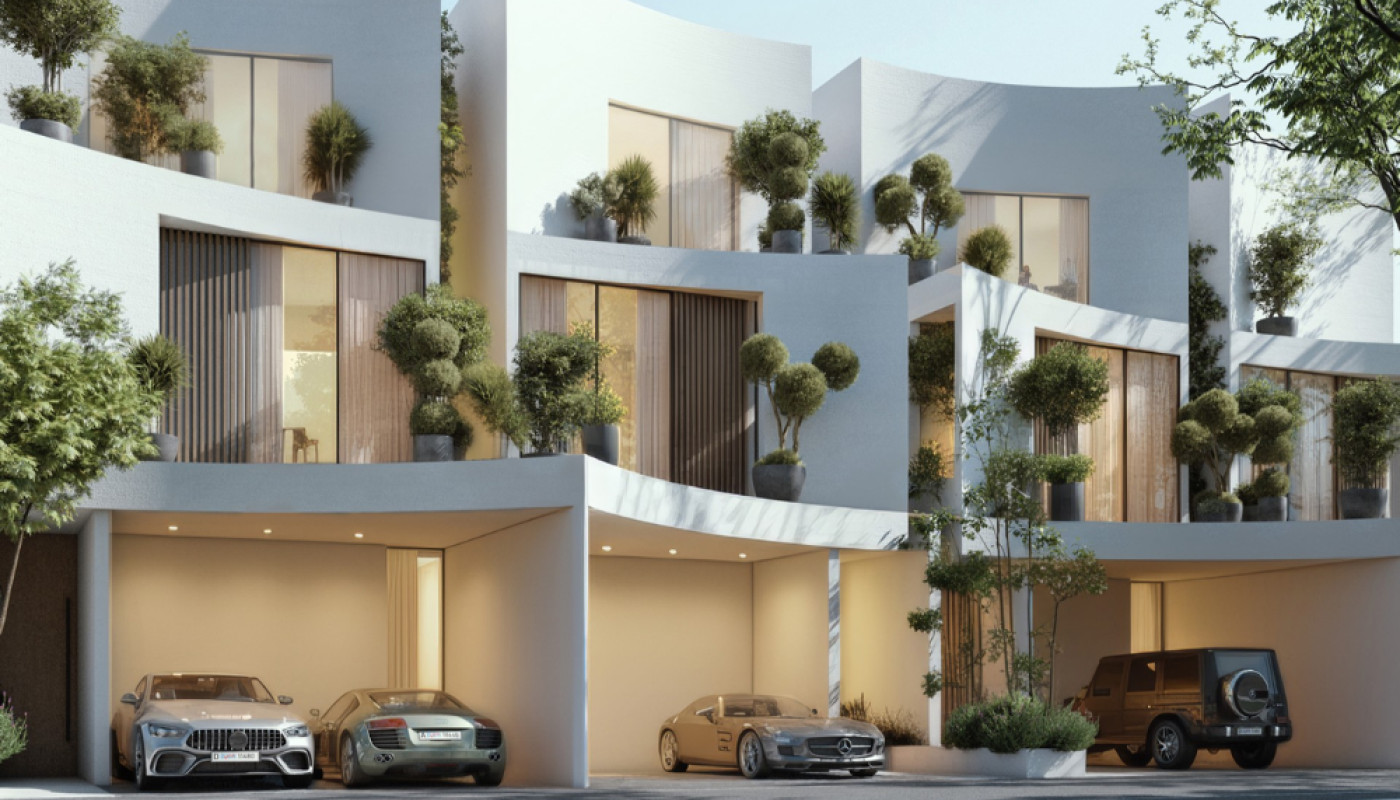
Lunaya’s architecture, contemporary Mediterranean in inspiration, leans on light stone, oak detailing and a restrained material palette that produces the consistency the segment rewards. The silhouettes are horizontal rather than vertical, with generous covered outdoor spaces and the indoor-outdoor flow that has become a signature of the higher end of the Dubai villa market. The references are recognisable, the contemporary villa traditions of St. Tropez, Marbella, the Cycladic islands, without being literal.
The choice of Mediterranean inspiration is itself worth noting. Dubai’s villa segment has historically drawn on a wider range of references, from the neo-Andalusian motifs of the early Emaar communities to the more cerebral modernism of some of the recent Sobha developments. The Mediterranean palette, with its emphasis on light, texture and outdoor living, has gained ground over the past several cycles as buyers have come to prioritise the experience of the home over its formal signature.
The Amenities and Their Calibration
The amenity programme at Lunaya, detailed in the published materials available through the official project resources, follows the current Dubai villa community convention. A central clubhouse. A kids club. A retail strip with curated food and beverage offerings. Padel and tennis courts. Landscaped gardens and walking paths.
The calibration of these amenities is, as noted, the central design question. Too much amenity, and the community tips into the resort category, with its associated maintenance overhead and its diluted sense of residence. Too little, and the community fails to produce the social texture that families increasingly expect. The published programme at Lunaya, while still to be fully delivered, suggests a calibrated approach that aims for the middle ground.
JLL’s residential outlook for the segment has noted that amenity calibration has become one of the principal differentiators between successful and unsuccessful villa communities. The brokerage’s data, drawn from resale performance across multiple communities, suggests that the well-calibrated communities, those with sufficient amenity to support daily life without tipping into resort territory, tend to outperform on long-term price appreciation.
Security and the Texture of Daily Life
Security is the original function of the gated community, and it remains central. The contemporary villa community manages security as an ambient condition rather than a foreground concern. Perimeter control, gatehouse staffing, internal patrols and the broader surveillance infrastructure that has become standard at this segment of the market all operate quietly in the background.
What matters, from the resident’s perspective, is the texture this produces. The well-run gated community feels secure without feeling fortified. Children move freely within the perimeter. The morning walk is unhurried. The evening return is unburdened by the security calculations that residents of less protected environments perform almost unconsciously. The new gated villa community off Sheikh Zayed Road is being marketed on precisely this texture, the practical experience of security rather than its visible apparatus.
A Final Reading on the Typology
The gated villa community is one of the most enduring typologies in luxury real estate because it answers a set of needs that does not change much across generations. Privacy. Community. Coherence. Security. The current generation of Dubai villa communities is working its way toward a more sophisticated resolution of these variables than the segment has historically offered.
Lunaya, in this reading, is less a launch than a position statement. The project is articulating what a 2026-era gated villa community in Dubai can look like when the design questions are taken seriously, when the architectural language is restrained, when the amenity programme is calibrated and when the privacy-community tension is resolved through circulation rather than left to accident.
Whether the project delivers on this position will, as always, be visible only after the community is occupied and the daily texture of life within it can be observed. The early signals, from the published master plan, the architectural materials and the conversations with the brokerage network, suggest that the developer has approached the design with the care the segment increasingly rewards.
Similar articles
.jpeg)
The Symphony: an exceptional real estate complex under construction in the heart of Meydan’s lagoons